
Wholesale reel planning is not just a low-price versus high-price decision. A useful catalog gives each tier a clear buyer, fishing scenario, and reason to exist.
Define the role of each price tier before adding SKUs. A catalog gets messy when two models chase the same buyer and the price gap is hard to explain. Wholesalers can review Laike as a starting point for available product categories.
Laike’s reel range provides several distinct directions to consider: Big Game Spinning Fishing Reels, Flat Metal Spool Saltwater Baitcasting Reels, and a Trolling Fishing Reel. These are not interchangeable products. Their different applications make them useful reference points when wholesalers need to plan a clearer product mix.
What Should Define a Budget Reel in a Wholesale Catalog?
A budget reel should be accessible without being unclear about its purpose. It often serves first-time buyers, general freshwater users, or retailers that need a dependable opening price point. The product does not need every specialist feature, but it should have a sensible configuration for its intended fishing scenario.
Broad-Use Spinning Reel Sizes and Accessible Features
Spinning reels are usually the easiest starting point for broad demand. They cover many general fishing setups. A wholesaler can build an entry assortment around a few useful sizes instead of stocking every model at once.
Laike’s Big Game Spinning Fishing Reels span sizes 1000 through 7000, with unit weights from 210g to 385g. Sizes 1000 through 5000 use 5.2:1 gear ratios, while sizes 6000 and 7000 use 4.7:1. Those differences give each size a clearer job in a wholesale range. A budget assortment can focus on the sizes that fit its channel; the full range does not have to be stocked from day one.
Avoiding Cost Cuts That Affect Basic User Experience
Lower price should not mean weak basics. A buyer still needs to check handle operation, line management, spool finish, drag adjustment, and the fit between reel size and the intended rod or line. If these basics are unstable, a low-cost reel can create returns and support work that wipe out the lower purchase price.
The practical question is not “What is the cheapest model?” It is “What can this model do reliably for the customer we expect to sell to?” That question produces a better entry tier and makes later upgrades easier to explain.
Which Features Justify a Premium Reel Position?
Premium positioning should be tied to a harder use case. That may mean saltwater exposure, faster retrieval, heavier drag, a specialist technique, or larger fish. A higher price needs a clear product reason, not only a different color.
Saltwater Protection, Drag Control, and Retrieval Requirements
Saltwater-oriented reels face different expectations from general freshwater products. Buyers may need corrosion-conscious materials or finishes, a suitable drag system, and a configuration that matches the intended line capacity and retrieve style. Confirm those details against the exact model specification and sample rather than copying a claim across a catalog.
Laike’s Flat Metal Spool Saltwater Baitcasting Reels combine a metal spool, 12+1 ball bearings, a 7.1:1 gear ratio, 6kg brake power, and 0.28/130 and 0.3/100 line-capacity options. The anti-corrosive finish and color choices make it a better fit for a baitcasting slot than a general spinning-reel slot.
For a premium saltwater specification, buyers should confirm the drag-washer material, main-shaft material, sealing approach, and body finish. Carbon-fiber drag washers, stainless-steel shafts, and anodized aluminum bodies can be useful options, but check them against the exact reel model. If the order requires 6kg or higher drag, test the sample under steady load instead of relying on a catalog line.
Big-Game, Baitcasting, and Trolling Use Cases
Premium does not need to mean one universal flagship. It can mean a small group of specialist choices. A big-game spinning range can serve customers who need a larger size selection. A saltwater baitcasting reel can serve a faster-retrieve or more application-specific position. A trolling reel can be reserved for offshore trolling and big-game contexts.
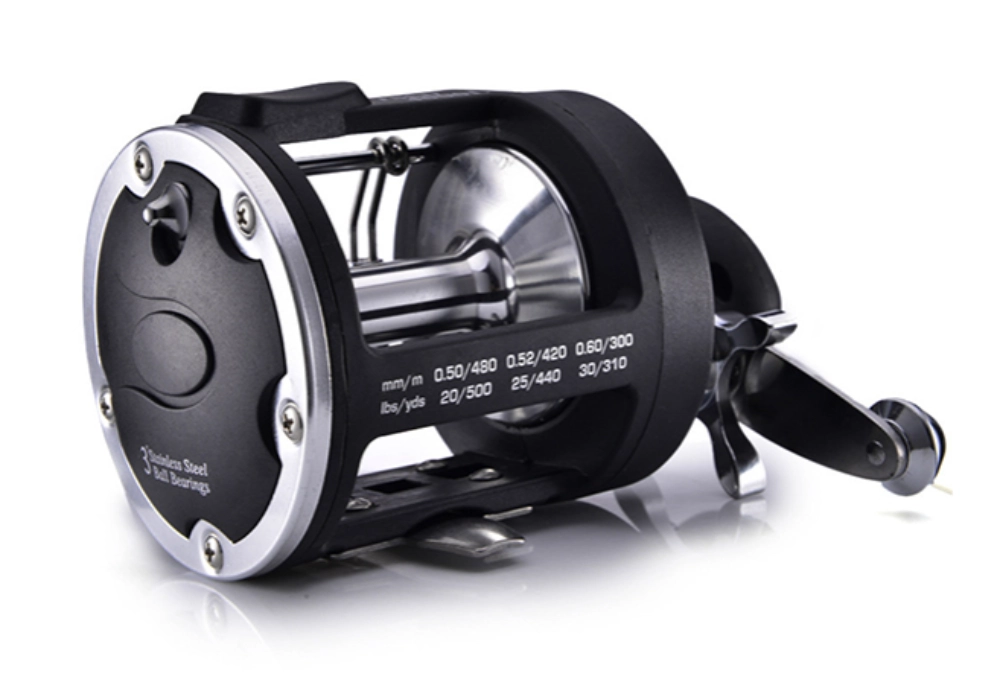
The Trolling Fishing Reel is positioned for offshore trolling and big-game applications such as marlin, tuna, or dorado. That makes it a specialist SKU rather than a replacement for an entry spinning reel. Keeping such roles separate helps wholesalers avoid stocking products that compete with one another without expanding the catalog’s useful coverage.
How Should Wholesalers Build Three Clear Price Tiers?
A three-tier structure helps buyers understand the catalog quickly. It does not need the same number of SKUs in every tier. The range should match actual demand, channel focus, and the company’s ability to support replenishment.
Entry Models for Volume Demand
The entry tier should cover accessible products with broad relevance. Choose a manageable number of reel sizes and clear product names. Focus on the scenarios most common in the target market, then make sure packaging and sales materials show what each model is for.
Mid-Range Models for Feature Upgrades
The mid-range is where a wholesaler can offer visible functional upgrades without moving immediately into specialist-only equipment. These upgrades may relate to size range, component arrangement, drag feel, spool design, or corrosion-conscious choices. The distinction must be clear enough that a retailer can explain it in a short conversation.
Specialist Models for Higher-Value Orders
Specialist models need a defined customer and application. Saltwater baitcasting, big-game spinning, and trolling can justify a focused SKU. The assortment does not need to be wide at first. It needs to make sense.
For the related purchasing questions of quality review and MOQ, see Cost, Quality, MOQ: A Practical Guide for Wholesalers Picking Fishing Reels.
How Can You Prevent SKU Overlap?
SKU overlap happens when two products target the same buyer but differ only in small, poorly explained details. It ties up inventory and makes catalog navigation harder. The remedy is to define every reel by a specific scenario and buyer type before it is added.
Give Each Model a Defined Scenario and Buyer Type
Write a short role statement for every model. For example: entry spinning reel for general freshwater retail; larger spinning reel for heavier setups; saltwater baitcasting reel for buyers who need faster retrieval; trolling reel for offshore specialist demand. These statements do not need to appear as marketing claims, but they help the purchasing team evaluate whether a new SKU adds coverage or simply duplicates another item.
Use Size Ranges and Feature Sets to Create Separation
Size ranges and feature sets can make the catalog easier to manage. Do not add a new model merely because it has a different finish. Add it when it creates a usable option for a different fishing situation, line setup, price point, or buyer profile. The same logic should be reflected in packaging and product data sheets.
What Should Be Confirmed Before a Wholesale Reel Order?
The final purchasing step should check the individual product and the assortment plan. A good reel does not solve a catalog problem if the model mix, packaging, or reorder plan remains unclear.
Samples, Specification Sheets, and Packaging
Review samples before committing to a larger order. Confirm the model name, size, gear ratio, specified line capacity, drag-related details, handle configuration, color, and packaging. Use the same approved data in the catalog, box artwork, and sales materials so customers do not receive conflicting information.
Reorder Planning for Fast-Moving and Specialist Models
Entry models may require more frequent replenishment, while specialist models may move in smaller but higher-value orders. Track them separately and set reorder expectations by tier.
Conclusion
Wholesalers should stock budget and premium fishing reels as parts of a planned range, not as competing versions of the same item. Start with broad-use entry models, add mid-range upgrades that customers can understand, and use specialist reels for defined saltwater, big-game, baitcasting, or trolling needs.
When every model has a clear buyer and scenario, the catalog becomes easier to sell, easier to replenish, and less likely to suffer from unnecessary SKU overlap.
FAQ
Are budget fishing reels only suitable for beginners?
Not necessarily. A budget reel can serve general-use customers well when its size and configuration match the intended fishing scenario.
When should a wholesaler add saltwater reel options?
Add them when the target market has a clear saltwater demand and the catalog can explain their intended application, corrosion-conscious features, and position relative to general-use reels.
How can a wholesaler reduce reel SKU overlap?
A: Define each model by its target buyer, fishing scenario, price role, size range, and key functional difference before adding it to the catalog.