
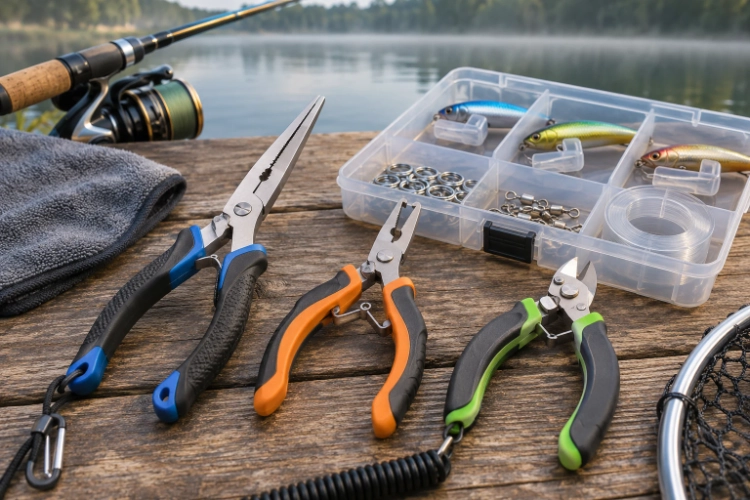
Choose fishing pliers by the job you do most often. Long-nose jaws help keep your hand farther from a hook. A split-ring tip makes lure hardware changes easier. A dependable cutter saves time when retying line. One tool can cover several jobs, but only if its size, nose and cutter match your tackle.
Start With the Hooks and Line You Use
The best fishing pliers for one angler can be clumsy for another. A fly angler working with small hooks needs precision and low weight. An angler changing treble hooks on hard baits needs a split-ring tip. Someone using heavier leaders may need more leverage and a cutter designed for that material.
Lay out the tackle you use on a normal trip. Note the largest hook, the smallest split ring, the thickest leader and whether you fish from a bank, boat, kayak or pier. This small inventory tells you more than a long feature list.
The Laike fishing pliers category provides a starting point for asking about available tools. Check the specification for the exact model before assuming it includes a ring tip, cutter, sheath or lanyard. Category placement describes the product family, not every feature on every tool.
Choose Jaw Length for Safe Reach
For hook removal, reach matters because it creates distance between your fingers and the hook. A longer nose can help when a hook sits deeper or when a lure has several exposed points. It also gives you a clear view of the shank while you rotate it free.
Longer is not always easier. A very long nose can feel less precise on small hooks and may require more hand force. Compact pliers fit a vest or pocket and give good control for light tackle, but they place the hand closer to the work. Choose enough reach for your common hooks without buying a tool so large that it becomes awkward.
Grip the hook by the shank or bend where appropriate, following safe handling guidance for the fish and the rig. Keep other points covered or controlled. If a hook is in a person, near an eye, or deeply embedded where removal could cause more injury, stop and seek appropriate medical help. Fishing pliers are tackle tools, not a substitute for medical care.
Match the Nose to the Task
A plain needle nose grips hook shanks, bends small hardware and reaches into tight spaces. Serrations may improve grip, though coarse teeth can mark softer parts. Close the jaws and look for uneven contact, twisting or sharp burrs.
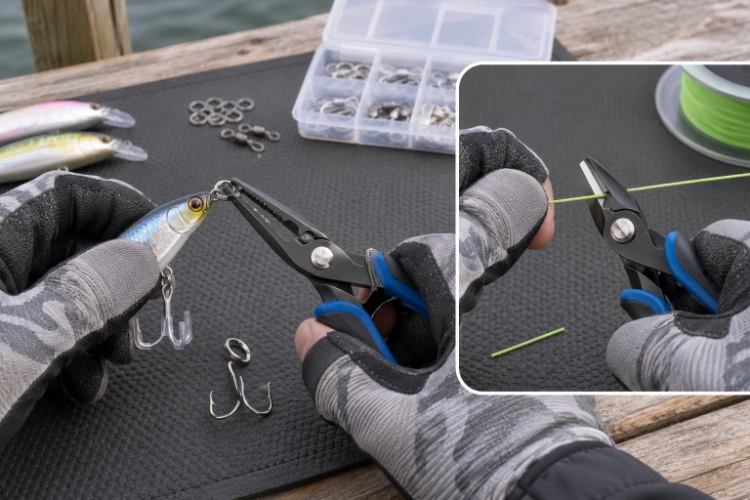
A split-ring plier has a small tooth or wedge at the tip. It separates the coils so you can slide a hook or swivel around the ring. The tip must fit the ring. A thick tip may stretch a small ring; a fine tip may struggle with a heavy one. Anglers who change both ultralight lure hooks and large jig hardware may be happier with two sizes.
Do not use ordinary pliers to pry a ring far beyond the opening needed to move the component. Distorted rings can fail to close properly. Work on a dry, stable surface, control the lure and keep treble points away from your hands.
Test the Cutter on Your Line
A cutter that handles monofilament may not cut braided line cleanly. Mono and fluorocarbon are single strands; braid is made from multiple fibers that can flatten or fray when a dull edge pinches them. Heavy leader also asks more of the cutter than light main line.
If possible, try a display or sample tool with clean pieces of your usual line. Make several cuts and inspect the ends. The line should not slip out of the cutter, and you should not need a two-handed squeeze for material within the tool’s stated range. Never test a cutter on hooks, wire or cable unless the manufacturer specifically permits that use.
Replaceable cutter inserts can extend the useful life of a tool, but replacements need to be available and the screws must be serviceable. A fixed cutter is simpler. In either case, rinse away grit, dry the tool and store the edge where it cannot cut line, fabric or fingers.
Think About Freshwater and Saltwater Care
Saltwater is hard on pivots, screws, springs and cutter inserts. A corrosion-resistant body does not guarantee that every small component has the same resistance. Coatings can also wear at contact points. Read the maker’s care instructions for the complete tool.
After saltwater use, follow those instructions for rinsing, drying and lubrication. Do not leave wet pliers sealed in a sheath or tackle box. Open the jaws so trapped moisture can escape, then check that the pivot moves freely before the next trip. Freshwater tools also benefit from drying, especially after exposure to mud, bait residue or rain.
Laike groups pliers within a wider tackle supply range. The company’s fishing-tool section also includes other tool categories. That makes it useful to compare the precise job of each tool instead of treating every metal accessory as interchangeable.
Check the Handle Pivot and Lock
Wet or cold hands change how a handle feels. Look for a shape that lets you close the jaws without your fingers sliding forward. Deep decoration is less important than secure fit, sensible width and smooth edges. If you wear gloves, test the tool with them.
Spring-loaded jaws can make one-handed use easier because the handles reopen after each squeeze. Check that the spring does not push the tool out of your grip. A lock keeps the jaws closed in storage, but it should not catch accidentally during use.
Open and close the tool several times. The motion should be smooth and the jaws should meet consistently. Excess side play can make a cutter or split-ring tip less accurate. A pivot that feels tight in the shop may become worse when dirt or salt reaches it, so regular cleaning matters.
Decide Whether You Need a Sheath and Lanyard
A sheath protects the tool and keeps the cutter covered. It should hold the pliers during normal walking while still allowing a controlled draw. Check whether the opening collects water and whether the material can dry between trips.
A lanyard is valuable when you fish above deep water or move around a kayak. Attach it to a secure point on the tool and to your belt, vest or boat. The coil should extend far enough for hook removal without pulling your hand back. A lanyard does not make careless placement safe; it simply reduces the chance of losing the tool.
For a small stream or fly vest, a compact tool on a retractor may be more comfortable than full-size pliers and a belt sheath. On a boat with larger lures, greater reach and a visible, secure storage position may matter more than low weight.
Use a Simple Buying Check
Before buying, run through five questions:
- Can the jaws reach and grip my common hooks while my hand stays clear of other points
- Does the split-ring tip fit the rings I actually use
- Does the cutter work on my stated mono, fluorocarbon or braid sizes
- Can I operate the handles, spring and lock with wet hands or gloves
- Do the sheath, lanyard and care instructions fit where and how I fish
The Laike product range can help you place pliers alongside hooks, lures, line and other tackle when preparing a kit. Keep the choice task-based: a tool earns space because it solves a real problem, not because it carries the longest list of claims.
Store and Use Pliers Safely
Cover exposed lure points before working on split rings or hooks at home. On the water, stabilize the lure and avoid holding it against your body. Do not use a cutter on energized wire, and do not apply a hammer, heat or an extension handle to force the jaws.
Wipe the tool after each trip, inspect the tips and cutter, and let the sheath dry separately. Replace a damaged lanyard. If the jaws twist, the cutter chips or the lock fails, stop using the tool until it is repaired or replaced.
If you need to confirm which current model matches your hook, line and carry requirements, contact Laike with those details. Ask for the exact model specification and care guidance rather than relying on a general product-family description.
FAQ
What size fishing pliers should most anglers choose
Choose a tool long enough to keep your hand clear of the hooks you use, but small enough to control with one hand. Many anglers can use a medium general-purpose tool, while small fly tackle and large treble-hook lures may justify different sizes.
Can fishing pliers cut braided line
Some can, but the claim should be checked for the exact tool and braid size. A dull or poorly aligned cutter can flatten and fray braid. Test clean line samples and follow the maker’s stated material range.
Do I need split-ring pliers
They are useful if you regularly replace lure hooks, blades or swivels. The tip must fit your rings. If you rarely change hardware, a plain long-nose tool and a separate cutter may cover your needs with less bulk.
Are aluminum pliers always better for saltwater
No. The complete tool includes jaws, pivot parts, springs, screws and cutter inserts that may use different materials. Judge the model’s construction, care instructions and tested use rather than the body material alone.
How should fishing pliers be stored after a trip
Clean them according to the maker’s instructions, dry the tool fully and let the sheath dry separately. Store the jaws closed or locked with the cutter covered. Check the pivot and lanyard before the next trip.